
What is Mohs?
Mohs micrographic surgery is the gold standard treatment for skin cancers around the head and neck.
Highest Cure Rate
• Up to 94% for secondary tumors
Patient Centered
• Local Anesthesia
Best Outcome
• Maximizes aesthetic result
Most Precise
• Spaces healthy tissue
Cost-Effective
• Includes pathology & wound repair
History of Mohs
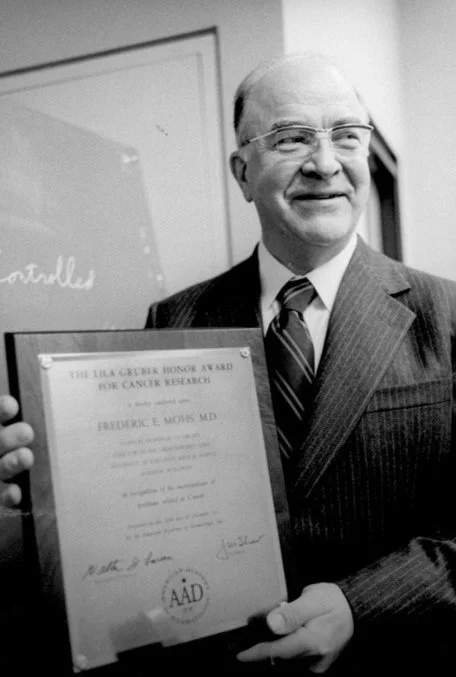
Mohs micrographic surgery was developed by its namesake, Dr. Frederic E. Mohs, during his medical studies from 1929 to 1934. Dr. Mohs applied techniques from his mentor, professor Michael Guyer, who specialized in preparing frozen tissue for microscopic exams. This method allowed Dr. Mohs to precisely identify cancer around essential structures like nerves and blood vessels. The technique has significantly evolved; by the 1950s, Dr. Mohs introduced fresh tissue excision, improving surgical results and reducing recovery times, which enabled immediate wound reconstruction. Today, the method's defining feature remains its detailed microscopic analysis of color-coded tissue maps. Ongoing technological advances, including cryostats for tissue freezing and automatic staining machines, continue to support its growth and incredible effectiveness.

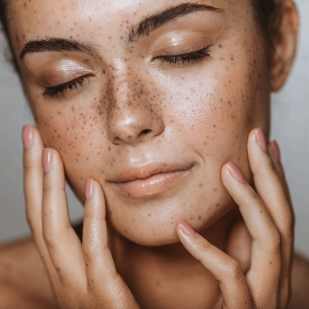
At the Mosher Center for Skin Care, we close every Mohs surgical site with techniques designed to give you the best cosmetic result, using plastic-surgery principles to make closures as natural, smooth and refined as possible.
Planning the Best Closure for Your Skin
Every wound is different, so Dr. Mosher will carefully assess:
The size and shape of the area
The natural lines and curves of your skin
How to close the area with the least tension and best cosmetic result
Dr. Mosher’s careful planning and surgical techniques are what helps the final scar blend in with your natural skin to be as minimal as possible.
Supporting the Deep Layer First
Before closing the surface, we place sutures (stitches) underneath the skin.
These hidden stitches are absorbable and:
Give the wound strength
Take pressure off the surface
Help the top layer come together smoothly
A tension-free closure helps the scar stay thin and even.
Lining Up the Skin Perfectly
Next, we bring the top layer of skin together with very fine, precise stitches—the same as what a plastic surgeon would use.
These stitches help to:
Keep the edges even
Prevent puckering or pulling
Create a smooth, natural-looking line
If the closure is on the face, special attention is given to matching features like the lip line, eyelid, or crease so everything looks as natural as possible.
Using Fine, Delicate Stitches on Top
The top stitches are not absorbable. We will make an appointment for you from 10-14 days out to have the sutures removed. These stitches are usually tiny and placed close together for accuracy and helps the skin edges heal cleanly with minimal marking.
Care After the Closure
Your role in the healing is important, too.
We’ll guide you on:
When to schedule an appointment to remove the stitches
How to keep the area clean and change your bandage
How to protect the scar from the sun
In the case of a graft, how to protect the wound from environmental factors especially the cold and smoke
Excellent aftercare greatly improves how the scar looks long-term.
Every patient heals differently, but these techniques are designed to give you the best cosmetic result
What to Expect
Postoperative complications are rare following Mohs surgery. As a fellowship-trained Mohs surgeon, Dr. Mosher is an expert in Mohs surgery and cutaneous reconstructive surgery and will manage any resultant complications that may occur.
Click here for more information on post-Mohs care.
Contact us immediately if you experience any postoperative complications.
Mohs versus Image-Guided Superficial Radiation Therapy
Comparing the 2 skin cancer treatments
Mohs
IRT
✓ Mohs only removes the skin cancer, preserving healthy skin.
X Radiation damages everything in its path, including healthy skin.
✓ 100% of the skin is evaluated to ensure complete cancer removal with Mohs.
X There is no confirmation that the cancer has been removed with radiation.
✓ Gold standard treatment for most skin cancers, even aggressive ones.
X Not recommended as a first or even second-line treatment option by national cancer guidelines.
✓ Cancer is cured in a single visit.
X Requires 15 to 20 treatments over several days to weeks.
✓ Over 99% cure rate.
X At least 1 in 20 will come back.
✓ Superior long-term cosmetic outcome.
X Unpredictable long-term cosmetic outcome.
X Can cause more skin cancers.
✓ CURES skin cancer.
X Skin irritation, blistering, peeling, color changes, hair loss, tooth decay, and damage to salivary glands, + more.
✓ Wound is repaired same day.
X Very Expensive.
✓ Cost effective.